

TL;DR
- Packaged Zoho CRM verticals sell in Australia at $75 per user per month on Professional, $125 on Enterprise, plus $350 up front to set the account up
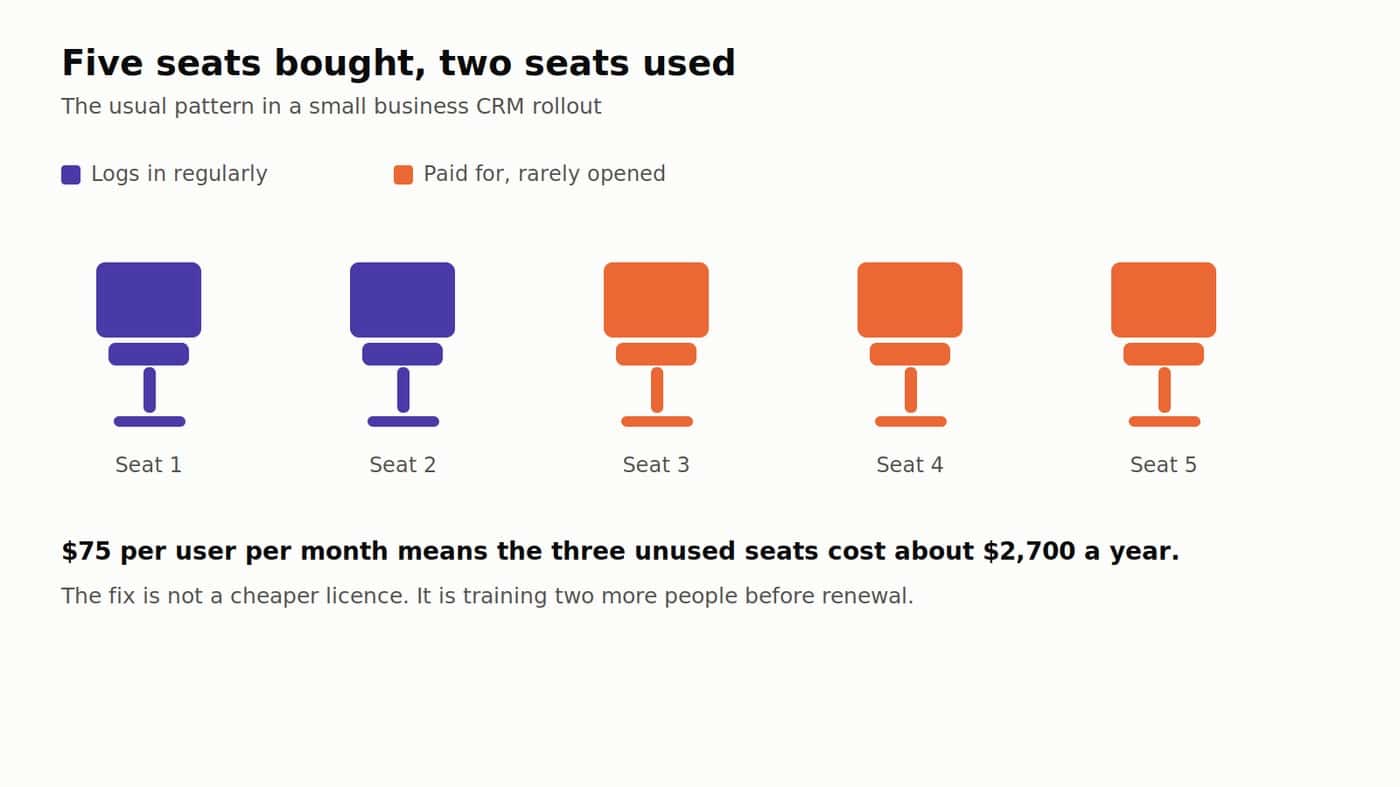
- On a five-person team that is roughly $4,500 a year at the lower tier, before anyone has been trained on it
- A 15-day trial with no credit card is long enough to find out how many of those five ever log in
- You are already required to keep most business records for 5 years, and company and some employee records for 7, so the storage question is settled either way
Short version: small businesses do not abandon CRMs because the software was wrong. They abandon them because two people learned it and three did not.
Ask an owner why the last CRM did not stick and you will almost never hear a complaint about features. You hear that it got messy. That only one person kept it up to date. That it was easier to just ring the client.
Three versions of the same answer. It is a habit problem, not a procurement problem, which is why comparing feature grids is close to useless when the team is under ten people.
The number that matters is not the licence fee
Australian pricing for a ready-made Zoho vertical is easy enough to establish, because several partners publish it instead of hiding it behind a form. Dynamic Digital Solutions Zoho CRM packages start at $75 per user per month excluding GST, with a $350 setup fee charged once per account and an Enterprise tier at $125.
Run that out. Five seats on Professional is $375 a month, about $4,500 across a year, plus setup. Real money for a business turning over a few hundred thousand. It is also less than one bad month of missed follow-ups, which is the comparison worth making. Not against a cheaper CRM. Against what the current arrangement leaks.
The awkward part is that the leak is invisible. Nobody logs the enquiry they forgot to call back.
Who in a five-person business opens it
Worth answering before you pay for anything, because seat count is where the budget goes and where the waste is.
| Role | Opens the CRM | What they need it for |
|---|---|---|
| Owner or director | Weekly, sometimes daily | Pipeline value, who has gone quiet, what is unbilled |
| Whoever answers the phone | Constantly | Finding the client, logging what was said, booking the next thing |
| Field or delivery staff | Only on mobile, only if it is fast | Today’s jobs, the address, the notes |
| Bookkeeper | Monthly, around invoicing | What was quoted against what was delivered |
| Part-time admin | Rarely, and reluctantly | Whatever the owner asked them to update |
Two of those five will carry the system. Buying five seats and training two is the commonest way a small business pays for software it does not use, and being honest at the start about who sits in each row costs nothing.
Training is the line item that gets cut first
The pattern is familiar from any business software rollout and it is not specific to CRMs. Licence approved. Configuration done. Training compressed into one afternoon because everyone is busy. Six weeks later the data is inconsistent and the tool gets blamed.
Learning business software works the way learning anything works. Short, repeated, task-shaped sessions beat one long demonstration, which is the same reason a guided approach to learning office software outperforms handing someone a manual and wishing them luck. Ask an implementation partner what share of their failed projects had proper training behind them. The answer tends to be uncomfortable.
Some partners bundle it in. Coaching and ongoing support inside the subscription, rather than sold as an extra, is worth more than a feature you will never switch on. Particularly from a firm that has been a Zoho partner for eight years and has enough advisory background to argue with you about your own process.
You have to keep the records anyway
Here is the argument that lands with owners who see a CRM as a sales toy. Whatever you decide about software, the paperwork is not optional. Australian businesses must keep most records for five years, and company records and some employee records for seven, counted from whichever is later out of receiving the record or completing the transaction it relates to.
Digital is explicitly fine, provided the records cannot be altered or damaged. So the real question is not whether you keep a customer and job history. It is whether that history lives somewhere searchable, or in an inbox and a drawer.
Put that way, a CRM stops being a growth purchase. It becomes the cheapest compliant filing cabinet available, one that also happens to tell you who has not been called in six weeks.
What to look at in the trial
Skip the feature tour. In fifteen days, test four things. Can the phone-answerer find a client in under five seconds. Does the mobile view load on a bad connection. Can the bookkeeper get what they need without asking you. And can you get your data back out.
The AI question can wait. Zia and Claude assistants inside the record, or a Retell AI voice agent taking calls and writing them up, are useful once the underlying data is clean and harmful before that. Automating a mess just produces more mess per hour.
The walkthrough below covers how a packaged Zoho suite fits together, which is the clearest way to judge whether the shape suits a team your size.
Video: The All-In-One Business Suite You Didn't Know About (watch on YouTube).
The test that predicts whether it sticks
Two weeks after go-live, look at who has entered data without being asked.
One person, and you have bought a very expensive personal notebook. Three, and the habit has taken, and the software will keep earning its $75 a seat for years.


